
In this guide
- Clarify words before comparing offers
- Compare foundations, transport and site assembly
- Separate product evidence from legal approval
- Choose the category through the intended use
- Use a classification question before comparing unit prices
- Compare options under the same constraints
- Create a defensible decision record
- Translate the decision into a comparable request for quotation
- Plan evidence, interfaces and the final handover
- A decision gate before choosing a delivery route
- Illustrative project exercise
- Conclusion
Procurement guidance by the HabKube project team. Examples and AI-generated images are illustrative, not documented customer deliveries or certified test results. Confirm technical and statutory requirements with qualified destination professionals.
Clarify words before comparing offers
A comparison to document
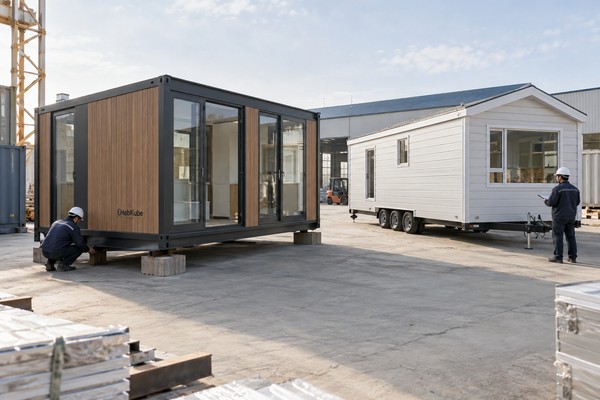
Prefab is a broad description of construction method, not a universal approval category. Modular may refer to sections constructed off site and completed under the destination’s building-code process; manufactured housing can be a specific regulated category in some markets. In the US, HUD defines manufactured homes under a federal program with particular construction and certification features. Other countries use different definitions. A shipping container conversion or portable cabin should not be assumed to fall into either category solely because it was built in a factory.
Ask every supplier to describe its product’s intended approval route, not just its name. Obtain drawings, construction standard, certification or inspection evidence actually available, and the proposed installation method. The destination authority and qualified local adviser should identify the classification for the exact site and use. This prevents a buyer from ordering an attractive unit that cannot be approved as the dwelling, workplace or temporary facility originally intended.
Compare foundations, transport and site assembly
A comparison to document
A modular unit may be shipped as volumetric sections, flat-pack components or panels; a regulated manufactured home may have a prescribed transport or chassis arrangement in its jurisdiction. These physical differences affect road permissions, foundations, utilities and the work remaining on site. Make a matrix of finished dimensions, transport dimensions, site work, local trades and inspections for each proposal. Do not infer that one category is always faster or cheaper.
The foundation and site connection must match the actual product and local approval. If the supplier quotes only ex-factory components, the buyer still needs design, permits, groundworks, delivery, assembly and commissioning. If a unit is marketed as “moveable,” ask what must be disconnected or repaired between uses. The ability to lift a structure is not proof that repeated relocation is approved or economical.
Separate product evidence from legal approval
A comparison to document
The supplier may provide material reports, factory inspection records and installation instructions. The authority may require plan review, approved inspection agency, a specific certification label or a local professional’s sign-off depending on classification. A test report for a wall panel does not substitute for a regulated home label or complete building approval. Conversely, a label for one regulatory category may be irrelevant to a different destination. Confirm document authenticity and applicability before deposit.
Where the term “manufactured home” has a precise legal meaning, avoid using it loosely in marketing or customs paperwork. Ask an import broker and destination adviser how the product should be described consistently across contract, invoice and permit application. Inconsistency can delay approval or create a dispute about what was promised. Keep change control if the unit’s intended use shifts from office to residence; the regulatory pathway can change even when the shell remains the same.
Choose the category through the intended use
A comparison to document
Write a use statement: who will occupy the space, for how long, where, and for what activity. Include accessibility, fire, energy and utility expectations that the destination professionals identify. Then compare products that can plausibly meet that route. If the project needs a permanent residence, a temporary site office specification is not a substitute. If the project needs a construction office, paying for a housing category that does not fit its local worksite approvals may not help.
Evaluate each option on a complete project schedule and cost basis. Include approvals, foundation, services, transport, installation, inspection and operating obligations. Ask suppliers to mark exclusions clearly. A trustworthy exporter should be able to identify what it can document and what needs destination review. It should not offer an undefined “international certificate” as a universal answer. The buyer’s decision record should retain the local adviser’s classification and the approved product description.
Use a classification question before comparing unit prices
A project-level decision exercise
Write a one-page statement of proposed use: residence, worker accommodation, office or retail; fixed or relocatable; exact destination; expected occupancy; and whether the structure will be installed permanently. Ask the destination adviser to name the applicable category and approval route before accepting supplier labels. In the United States, a HUD-regulated manufactured home has a specific federal framework, while a different factory-built structure may be reviewed under another route. The same everyday word can mean different things across markets.
Then ask two suppliers for evidence against that one-page statement. One may offer a product with a certification process that fits the use; another may supply a modular shell requiring local design and permits. Neither is automatically better, but their price and schedule must include the respective obligations. Ask what remains after the factory finishes: transport, foundation, utilities, site inspection, labels or local sign-off. If the buyer compares only the delivered shell price, the regulatory difference disappears until too late.
Finally, test a proposed use change. If a temporary office becomes housing, which original documents remain relevant and which approvals must be revisited? The buyer should not rely on the fact that the walls look residential. Keep the authority’s category decision and product description attached to the contract. This exercise is particularly important for export transactions because customs terminology, sales language and building permission can diverge. A precise classification is a safeguard against both compliance and commercial misunderstanding.
Compare options under the same constraints
An implementation check for the buyer
Start with the buyer’s non-negotiables: legal use, site, expected duration, climate, occupancy, room functions, performance and budget basis. Every alternative should answer the same brief. Otherwise a cheap shell can appear to defeat a fully installed option simply because its missing work is invisible. Ask bidders to separate supply, local design, approvals, freight, foundations, services, installation and handover. Note any differences that cannot be normalized without a further professional review.
Use scenario checks rather than one “best” score. What if access narrows, an opening moves, occupancy changes or the building must be reused? Some options tolerate a late design change better; others depend on early factory release. Identify which uncertainty is material to this project. A comparison table should show evidence source and confidence beside cost and time. If the destination classification or permit route is unsettled, do not present a forecast as a guarantee.
Keep supplier claims in proportion to their evidence. Factory work can improve repeatability in some conditions but does not automatically reduce cost or guarantee quality. A familiar local method can simplify some repairs but can also add site variability. The buyer should inspect drawings, processes and responsibility boundaries for the actual offers. Avoid turning the article title into a universal recommendation. The right conclusion may be a hybrid solution or a decision to wait until the site facts are known.
Project brief
Establish the regulatory category first
Send HabKube your intended use and destination so product scope can be discussed alongside your local adviser’s classification.
Get a project quote
Create a defensible decision record
An implementation check for the buyer
For each option, write down the assumed product, approval path, key dimensions, delivery method, site scope and operating responsibility. Assign a named owner to unresolved points and a deadline before they affect fabrication or contract commitment. Include the cost of verification, not only the cost of supply. A quotation that needs local engineering, brokerage or a specialist inspection is still viable, but those services belong in the project plan.
Review the decision with people who will install and operate the building. Purchasing may focus on unit price while facilities staff notice inaccessible parts or an awkward route. A local designer may identify a classification conflict that an exporter cannot resolve. Record objections and their resolution; an unresolved issue should not disappear when a preferred option is chosen. This is especially important in cross-border procurement, where product names and code pathways may differ.
Once selected, preserve the comparison as the basis for change control. If the owner later alters use, quantity, location or schedule, revisit the assumption that drove the choice. Compare the final delivered scope with the decision record after the first phase. This is not about proving the initial team right; it is a way to make later purchases more informed. Publish only real, verifiable outcomes as case evidence. Hypothetical exercises in a buyer guide should remain clearly labeled.
Translate the decision into a comparable request for quotation
An implementation check for the buyer
Write an RFQ around the decision in this guide: clarify words before comparing offers. State the application, destination, intended duration, quantity, site information available and the date by which an approved configuration is needed. Attach one controlled drawing register and name the assumptions that are still open. Ask every bidder to mark each requirement as included, optional, excluded or awaiting buyer input. This is more useful than asking for an all-in figure when the material, factory scope, local work and freight basis may differ. A lower bid can then be traced to an actual difference rather than an unexplained total.
Request a line-item scope for product, finishes, factory checks, export packing, freight, site support and commissioning where relevant. Agree the named delivery place, currency, quotation validity, proposed schedule and change method. Where a calculation or certificate is needed, ask who will provide it and whether it applies to the proposed configuration. A product catalog can help narrow options; it should not be used as the contractual design. The buyer should keep a list of decisions whose late change would affect tooling, dimensions, components or local approval. Put a release owner and deadline beside each one.
Compare supplier answers in a matrix with columns for proposal, evidence, exception, owner and next decision. Record whether an answer is a measured fact, a quoted option, a preliminary assumption or an issue reserved for a destination professional. For prefab house vs manufactured home, that distinction matters because commercial language can sound final before the site design is ready. Ask the supplier to explain the basis for any performance or delivery claim. The result should be a decision record the purchasing, technical and installation teams can all understand, not an email chain that only its original authors can interpret.
Plan evidence, interfaces and the final handover
An implementation check for the buyer
Make an evidence list for the risks described above, especially compare foundations, transport and site assembly. Identify what can be checked at material receipt, during factory production, before shipment and after installation. Those stages do not prove the same things. A visible factory mock-up can confirm geometry and workmanship; it cannot certify a complete building or replace the destination authority. If a report is offered, match its specimen, method, configuration and date to the current order. For each unresolved issue, record the specialist or authority that will decide it and the latest practical decision gate.
Divide responsibility at physical interfaces. Factory-supplied parts, foundations, local structural connections, service terminations, import clearance and occupancy approvals may belong to different parties. Put one owner and one acceptance record beside each interface. Sequence delivery so the site can receive, unload and protect the package safely. Match labels and loose hardware to assembly drawings, and provide receiving staff with dimensions, weights and inspection points before the truck or container arrives. Report transport damage promptly against package IDs while the original condition can still be reconstructed.
At handover, retain approved and as-built drawings, product references, relevant inspection records, operating limits, maintenance instructions and written warranty scope. Link them to actual unit IDs. Identify who can make a later change and when local professional review is needed. Ask the operator to review the building after its first period of use, noting access conflicts, leaks, unexpected wear or service difficulty relevant to this topic. Resolve the underlying cause before duplicating the detail in a later order. This is a practical learning loop, not a claim that a hypothetical example is a delivered HabKube project.
A decision gate before choosing a delivery route
An implementation check for the buyer
Summarize the preferred option in one page: intended use, destination approval path, installed scope, expected programme, full cost basis and the most important assumption. Ask technical, commercial and operating stakeholders to sign off on what remains uncertain. If an approval path is unresolved, a conditional selection is more honest than a final commitment based on labels.
After the first phase, compare actual records with the assumption that drove selection. Did the critical date, transport constraint or local approval behave as forecast? Record the answer and use it to revise future decisions. A buyer guide can supply questions and frameworks; only real project records can establish whether a chosen route delivered the expected result.
Illustrative project exercise
Use this example to test the decision
Illustrative review: a buyer sees a flat-pack office advertised online as a “manufactured home” and plans to use it as a permanent residence in the US. Before ordering, the buyer needs local classification and approval advice; a factory-built shell alone does not establish HUD certification or local residential permission. This is a hypothetical category error, not a HabKube product claim.
External reference
Use the right reference for the right decision.
HUD defines a specific US manufactured-housing regulatory category. Other factory-built products and other countries may use different terms and approval paths.
Read HUD manufactured housing homeowner resourcesConclusion
Clarity before commitment.
Compare factory-built products only after defining their legal use and approval category. The right term on a quotation is less important than a documented path to lawful installation and operation.
Related HabKube resources
Ready when you are
Request a clear product-scope discussion
Email info@HabKube.com with site, use, quantity and any local requirements. We can explain the proposed modular configuration without claiming universal residential certification.
Send your requirementsCommon questions
Before you request a quote.
Are prefab and manufactured homes the same?+
No. Prefab is a broad construction description; manufactured home may be a defined regulatory category. Check the destination’s rules and exact product.
Does a factory inspection replace a HUD label?+
No. Where HUD manufactured-housing rules apply, their specific certification and enforcement process matters.
Can an imported modular office be used as a home?+
Only after the proposed residential use, product design and approvals are reviewed by competent destination parties.
What should I ask before paying a deposit?+
Request the intended regulatory category, applicable standards, available evidence and the local approval path for the exact site and use.